Dan Turkel
Craigslist as Boston’s Digital Supplement and Alter-Ego
Nota bene: This essay was written for an assignment on “digital urbanism” and is currently presented in its original state. I have since received some feedback on the assignment and hope to make some minor additions in the future.
“Clap if you use Craigslist” says comedian Aziz Ansari, warming up the crowd. The response is enthusiastic applause and a handful of shouts. Ansari then proceeds to (hilariously) paint a dark image of Craigslist where concert tickets are exchanged for sexual favors under less than ideal circumstances. The bit lands because, fairly universally, Craigslist has something of a reputation for seediness.[1]
The reputation is of course not entirely undeserved. For instance, in many cities, the “Talent Gigs” section is largely casting calls for amateur pornographic productions:
$30,000+ CASH, 8 hours, private video shoot, never made public
Looking for very hot, sexy, open minded girls who are looking for a lot of money fast. These video shoots are kept private (legally binding contract signed by all parties) and fun. Ideally looking for very hot White or Asian girls. Email for more info.
Originally posted March 27th, last updated April 15th.[2]
If the ability to exchange lewd “services” (which should not be misconstrued as inherently illegitimate business exchanges) doesn’t put people off, the extensive “Casual Encounters” and personal ads sections seem to ring alarm bells for many users. But the easily skeeved reader should be aware that the content on Craigslist’s seedier sections is nothing worse than what one might find in the back of a Village Voice: the sheer diversity of content, mundane and extraordinary, quotidian and deviant, on Craigslist should be seen as nothing more than a reflection of the neutrality of the medium itself. In this way, Craigslist serves as a digital alter-ego to each the 700-plus cities it represents. Craigslist allows for the creation of a digital layer of the city, ephemeral and liberating in its digitality (and thus anonymity) but grounded in the geography of the place which brings with it the promise for meaningful in-person encounters, whether it is for selling a bike or a one-night stand.
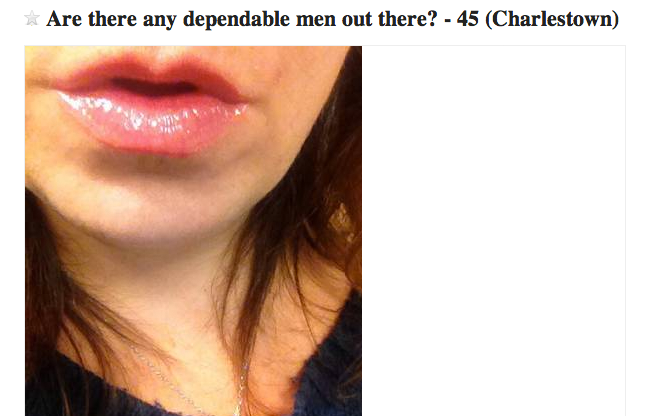
A personal ad posted in “Women Seeking Men.”
Narrowing Our Scope
Since Craigslist is an enormous and ever-expanding site, it is necessary to limit our study to a single city sub-site. Since I am writing this in Boston, what better city to pick? Boston was the first city added to Craigslist after it served San Francisco exclusively from 1995 to 2000. It is also subdivided into five regions: “GBS” for Boston, Cambridge, and Brookline, “NWB” for Northwest and Merrimack, “BMW” for Metro West, “NOS” for North Shore, and “SOB” for South Shore.
While much of what we discover is likely not exclusive to the Boston Craigslist site, this does not mean that it is not specifically relevant to Boston. Craigslist is a digital medium and thus, to an extent, is without a physical grounding. Thus any city’s Craigslist site adapts itself to the needs and wants of the populace of that place, with its peculiarities and proclivities. To outline just what makes each city’s Craigslist site different would be a much larger project far out of the scope of this one, but we will regardless be able to see the way in which Craigslist serves as a tabula rasa which is shaped to fit a populace (by that populace).
A Brief Bit of History
Before delving too deeply into what Craigslist looks like today in Boston, it is worth it to take a quick diversion into Craigslist’s origins. Craig Newmark started Craigslist as an email list to help newcomers to San Francisco, like himself, find out about local happenings. It quickly grew and a year later, craigslist.org was registered to move the email list onto a webpage, now with job listings in addition to just events, and the growth just continued from there. Sometime around 1999, Newmark made Craigslist his full-time job and had nine employees working in the makeshift office that was his apartment.
The year 2000 saw the expansion of Craigslist into something more like its modern incarnation. Jim Buckmaster joined the company and added a wealth of features that are today standard. The new feature most important for our purposes was the structure which allowed for multiple cities to have their own Craigslist sites. In late 2000, Buckmaster became CEO, and the site has simply expanded its scope (even intercontinentally) and very moderately increased its feature set since then. The site is primarily financed by paid job listings available in some of the larger cities’ sites.[3]
Craigslist as Supplement
In a number of ways, Craigslist serves as a supplement to Boston, benefiting the citizens but effectively untethered from the physical space. The discussion forums operate as effectively placeless sites for talk on everything from marriage to money to “kink and bdsm.” The fact that the participants in these discussions happen to be (presumably) all in Boston is effectively irrelevant: the discussion forums serves as a piece of the digital commons, a digital piece of public sphere wherein participants can converse about issues that effect them, local to Boston or universal to the human experience.
So why bother to link these forums to Boston at all? For one, the discussion of issues (or non-issues, like hobbies or interests) among one’s local peers allows for a building of community. Newcomers in a city (the original target for Craigslist’s earliest incarnation) can immediately participate in a conversation with the Boston populace without knowledge of geographic meeting places or interest-based organizations. Craigslist lowers the barrier of entry for a citizen to enter the public discourse in Boston. The accessibility and ubiquity of internet grants power to anyone interested in becoming an agent of discussion in Boston. And in addition to community building, geographically centered forums have a plethora of practical applications.
But the discussion falls flat without examples. An example of non-local conversations that Bostonians can participate in through Craigslist would be those in the photography forum. One thread ponders a photography project of prisoners in solitary confinement—the poster presumably just wanted to talk about the project with his or her interested peers. But even though photography discussion is not inherently fixed to a place, the forum is also clearly beneficial to locals, like this one looking for a photo buddy for a night shoot. Thanks to this forum, though perhaps shamefully underused, Bostonians interested in photography can (e)-congregate to talk shop whether it means getting together or staying behind the comfort of their computer screens.
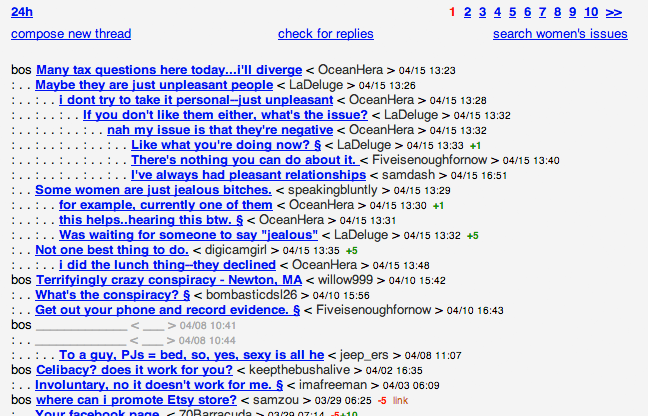
A screenshot of the Boston “Women’s Issues” forum.
The housing forum, on the other hand, clearly has local-specific use. Discussions range from advice to avoid a certain agency to a search for a place to crash. Rather than seeking advice from a potentially small network of educated “real-life” peers, Craigslist provides a centralized space for the sharing of information among the interested. And the utility of the housing forum is backed by its frequent usage, with forty posts already this month.
The last site of interest in the area of supplemental discussion forums is the “Rants and Raves” section. “Rants and Raves” is not a forum proper in that it is post-based (rather than thread-based) and replies are simply new posts which reference an old one in their headline (assuming you saw and remember the referent). Nowhere are content guidelines delineated and so “RnR” becomes a de facto soapbox for everything from public service announcements (“Danger! Make sure your [sic] not using this HVAC Company or you can die”) to editorial content (“Enough already [with ‘Boston Strong’]”) to non sequitur personal anecdotes (“My mom is crazy”). Below is an exchange I found particularly noteworthy:
WEED! - 51 (Dorchester)
I was in back of this car a KIA, MA. # 376.FT1 today on April 15,2014 at 12:pm on Boston street near Dunkin Donuts in ***DORCHESTER, MA. with two people in the car smoking weed while driving! Yes, i was was in back of them for a few blocks with the the nice smell and seen them also pass the F%^%^%$#$##### S^&*T. to each other a few times.
Originally posted April 15.
Lo and behold, one hour later:
re WEED! - 51 (Dorchester) - 53
You could follow my car for 35yrs and you would smell weed. Who fucking cares, any different from you taking xanax or drinking?
You were using your phone while driving, go clean your fucking streets.
Originally posted April 15.
Followed by about five more obscenity-filled responses as the hours passed (and continue to pass). Sure, the language is less than civil, but a forum suited to the public airing of grievances and shaming actually fulfills a public service and if it inspires heated debate, then this is ultimately all the better for the community. So not only is the price of curse-filled noise worth the benefit of public-serving signal, but even the noise ultimately serves to give voices to those who might be excluded from more traditional discussions.
But Craigslist is not just a supplement to Boston, enhancing it and building functionality onto the pre-existing metropolis: it is also an entirely separate Boston unto itself, a digital alter-ego, both a utopia and underworld.
The City That Is Craigslist: Boston’s Alter-Ego
Craigslist Boston is a second Boston, built invisibly on top of the physical one we walk through every day. Not only does Craigslist contain the many facets which make up a city, it provides a semantic ordering and organization when the two Bostons are overlaid.
The urban facet of Craigslist Boston most commonly utilized is probably the “For Sale” section where users post goods ranging from antiques to appliances to auto parts to boats to books to jewelry to just about anything.[4] The popularity of Craigslist means that if I’m looking to buy some electronics, I can go to the electronics page of the Boston, Cambridge, Brookline Craigslist and find 509 listings posted just today. Then if I find something I like, say a handful of XBox 360 games, I contact the seller and arrange to meet him or her to exchange my cash for the games.
This is where where we should stop to think. Arrange to meet someone from the internet? Everything children are taught about using the internet suggests an invisible boundary between the worlds of cyberspace and meatspace that must never be crossed, lest the criminals and deviants lurking on the internet reach our real-world bodies. But Craigslist is based entirely on the violation of that principle. Craigslist flourishes on the seamless interaction between the digital and the physical, the use of the internet to organize a locale. Without that principle, it wouldn’t work at all.
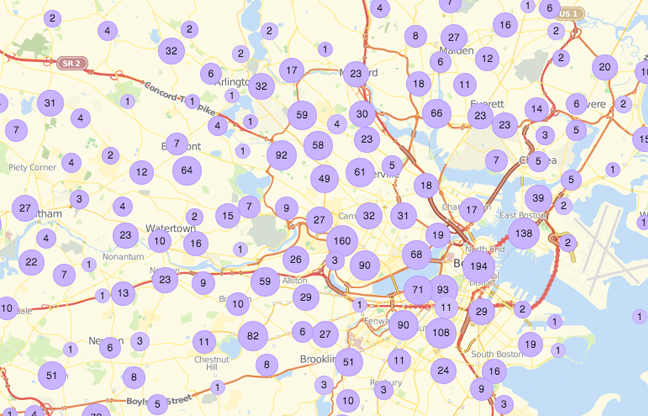
A map of Boston’s “For Sale” Craigslist postings.
This is what I mean by the two Bostons overlaid. Much of Craigslist’s greatest utility is when its digital power is utilized to order the chaos of the physical city. Perhaps Anthony Townsend puts it best in his essay “Thinking in Telepathic Cities”:
Another aspect of this new consciousness is the new, and perhaps most important, role of the physical city, which is to serve as a substrate upon which layers of information and data can be referenced. As Alex Pang points out in his chapter in this volume, unlike the alternate realities of early cyberpunk, what we see emerging today is a complex geographic web of information encoded to real physical places. Increasingly, what and who are physically present in a specific urban location may not be as valuable as historical, cross-referenced, or future information that will be stacked up in the co-present virtual space. We may think about cities as information spaces to be navigated, and browsed more efficiently with our bodies.
(Townsend, 71-72)
Thus we can see how Craigslist serves as more than just a supplement to Boston, where a supplement implies something added onto an already complete whole. We use the term alter-ego here to demonstrate that Craigslist represents the other half of the city without which the physical half is, today, incomplete. Craigslist is a dynamic mapping system that mediates and orders the physical city into semantic subcities. The above map of “For Sale” rebirths Boston as a micro-scale commercial zone, whereas the below map reveals the locales of some of those “Talent” listings mentioned earlier.
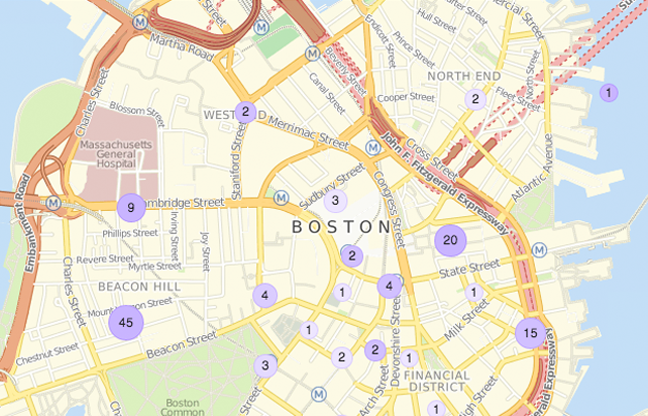
A map of Boston’s “Talent” Craigslist postings.
Craigslist suddenly seems to expand the city, telepathically, to confront some of the inherent problems of maps that Harvey Molotch discusses in his essay for City A-Z. Molotch laments the focus on geography to the detriment of cultural mapping. While Craigslist may not show the “route which blacks might prefer in Johannesberg” or explicitly plot crime, it does let you find the nearest babysitter, class, volunteer or job opportunity, masseuse, or cell phone for sale near you. There simply is no way to navigate the solely physical Boston in such a semantically organized way without the decentralized, self-governed invisible layer that is Craigslist’s ability to augment and map the city.
(The biggest disappointment is that personal ads are not viewable on a map—just imagine the possibilities! Where’s the man seeking men nearest me? Which neighborhoods have the greatest density of women seeking “miscellaneous romance”? Where are all those insane rants and raves coming from? The ability to map not just goods, services, and people onto Boston but emotions desires would be have incredible anthropological and sociological consequences for those curious enough to take a careful look.)
Craislist Is Different and Important
As cities expand and grow denser inside, the absence of (telepathic) mediating technologies could lead to cities as spaces of isolation. In fact, perhaps 21st century Boston—the exclusively physical city without the aid of benevolent technology (not just Craigslist, but Yelp, bus trackers, or Grindr)—is an isolating and alienating space. As the ability to mediate our physical navigation of the physical city via digital technologies (and their respective digital city, layered atop the physical) increases, perhaps we cease to create or continue our previously typical aids to the physical traveler. We toss out phone books, demolish phone booths, and ditch newspapers for iPads on our morning commute. What if the assumption that everyone has a smartphone makes it a faux pas to ask a stranger for directions or a restaurant recommendation? Or if headphones become ubiquitous to the point where talking in public is not just frowned upon but considered totally unnecessary?
What if digital forums work so well that we don’t need to meet as groups in person anymore? What if bars and clubs shut down because we find our anonymous partners through smartphone apps instead?

Film still from The Matrix showing the pods where everyone is asleep, living in an entirely digital reality. Source.
I contest that Craigslist specifically prevents us from moving towards a wholly (or predominantly) digital world where the physical serves solely as a vessel for the actions we have digitally mediated. Remember: Craigslist’s local sites, like Craigslist Boston, and its geotagged listings provide the core of its utility in that it encourages face-to-face interaction and meetups. Craigslist is not just a supplement which could perhaps one day takeover the physical city it once added on to, it exists in a symbiotic relationship with the physical Boston. Boston becomes easily navigable to the would-be citizen thanks to the mediation of Craigslist, and Craigslist is rooted in the commonality of a locale, namely (in this case) Boston. Whether you want to spend a summer afternoon with a printed out map going from one listed garage sale to the next, or want to plot out a dérive filled with odd sights (locations of porn shoots?, sites for day laborers to gather?, web-organized protests?) in the style of the Parisian situationists,[5] seeking routes that are spiritually fulfilling while not imposed top-down from the city onto the citizen, you can if you combine some web-smarts and street-smarts.
Concluding Thoughts
A world heavily influenced by technological advances is a fast-paced one. As such, it is hard to grasp onto a situational status quo for long enough to analyze it thoughtfully before it’s been obsoleted by the latest revolution (like how “Tinder revolutionizes the hookup scene,” “Venmo revolutionizes interpersonal payment”).
But some things don’t seem to change. One of those things is human nature, and as vague or cheesy as that may seem, I mean it. Our humanity is what keeps us making lunch dates even when we could just Facebook chat, what keeps us talking to strangers on the train when we could just block out the world with headphones, what keeps us from leaving the comfort of the glowing screen for anything other than using the bathroom, eating, and perhaps a job. So long as we are human, we will continue to adapt new technologies to our human ways of living—using sites like Craigslist to supplement our city and augment it with a useful alter-ego in social, commercial, or just fun ways; to find our next job or our next lover; or to share a lingering thought with those around us.
Retrospect (My Life)
I have had a difficult life and have overcome much adversity in that time. I am 53 [years] old now and am surviving cancer for about 1 1/2 years. I deal with allot of pain and sometimes I can handle it other times I can not. I go to bed some nights hoping my poor wife will put me down when I (sleep). I live in fear of the next symptom. I really have tried to overcome this fear and live in the now but that is one of those things that is easier said than done. I have blown all of my savings since before Christmas trying to help other people and the holidays. I just had to solidify in my mind that you can not buy good karma. I wanted to feel that I was doing the right thing. But I guess not. Well thats it I have nothing left to give so I will leave you hoping for peace and prosperity for you all.
Originally posted April 14th in “Rants and Raves”
Love the spring time - m4w - 30 (Anywhere)
Love this time of year when it’s not too cold, not too hot. Plants are starting to grow, everything seems new and fresh. Would love a chat/email partner to just help pass the day away and make me forget I’m in a cube as opposed to outside. Anyone else care to be distracted?
Originally posted April 15th in “Strictly Platonic.”
Footnotes
- Craigslist users worried about their personal safety can refer to Craigslist’s safety page. ↩
- All Craigslist links expire based on a set timeline so these links may die without notice. This is why I have copied the text from Craigslist postings when relevant rather than solely relying on hyperlinks to them. ↩
- Information in this section was obtained primarily from the Wikipedia article, cited below. ↩
- Admittedly, not just anything is technically allowed on Craigslist, as certain items are specifically prohibited. However, the site is run in a fairly laissez-faire fashion, relying on community moderation to flag prohibited or abusive content. ↩
- See “Trails” by Jane M. Jacobs in City A-Z, cited below. ↩
Bibliography
“Craigslist.” Wikipedia. Wikimedia Foundation, 13 Apr. 2014. Web. 15 Apr. 2014. <http://en.wikipedia.org/wiki/Craigslist>.
“craigslist | about.” Craigslist. N.p., n.d. Web. 15 April. 2014. <http://www.craigslist.org/about/>.
The links on Craigslist’s About page were immensely helpful in getting data on the scale and expansion of the site, as well as links to certain site policies.
de Certeau, Michel. “Walking in the City.” The Practice of Everyday Life. Trans. Steven F. Kendall. Berkeley: University of California Press, 1984. 91-110. Print.
Jacobs, Jane M. “Trails.” City A-Z. Ed. Steve Pile, N. J. Thrift. London: Routledge, 2000. 265-267. Print.
Molotch, Harvey. “Maps (2).” City A-Z. Ed. Steve Pile, N. J. Thrift. London: Routledge, 2000. 143-144. Print.
Townsend, Anthony. “Thinking in Telepathic Cities.” Integration and Ubiquity: Towards a Philosophy of Telecommunications Convergence. Ed. Kristóf Nyíri. Vienna: Passagen Verlag, 2008. 63-73. PDF file.